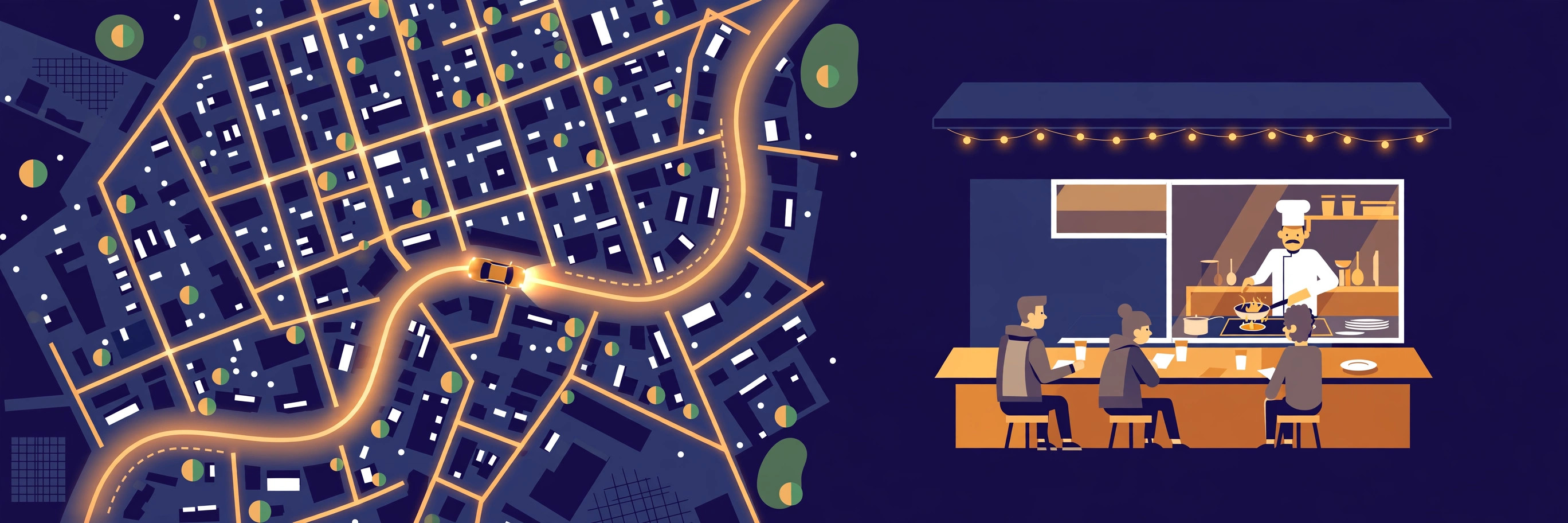
You have watched that little car crawl across the Uber map. It turns corners that do not quite exist, glides through blocks, and seems to take the scenic route even when your driver is two streets away.
Here is the uncomfortable part: the car is not really there to tell you when your ride arrives. GPS already knows that. The car is there to manage you — your patience, your perception, and how much you think the service is worth. And it works so well that the same trick now sits inside almost every booking, order, and delivery you make.
It also happens to be one of the best-documented effects in behavioural science. It has a name: the labour illusion. And small businesses and nonprofits can use it honestly, for free, starting this week.
What the research actually found
In 2011, Harvard Business School researchers Ryan Buell and Michael Norton published a study in Management Science called "The Labor Illusion: How Operational Transparency Increases Perceived Value." Across five experiments with simulated travel and dating websites, they showed people two versions of the same service. One returned results instantly. The other made people wait — while showing its work, ticking through the airlines and sites it was supposedly searching. The results, when they arrived, were identical.
People preferred the slower one.
In one experiment with 266 participants, the group that watched the search happen rated the service about 8% more valuable — at every wait length tested, from a few seconds to a full minute. The researchers' explanation: seeing effort triggers reciprocity. When a service visibly works on your behalf, you feel it has done something for you, and you value the outcome more. An instant result, however good, feels like it cost nothing — so we price it that way in our heads.
Buell then took the idea out of the browser and into the real world. In a 2017 field study with Tami Kim and Chia-Jung Tsay, run in a university cafeteria serving up to 1,600 diners a day, the team installed video "windows" between the grill cooks and the customers ordering from them. Four setups: neither side could see the other, only one side could see, or both could.
When customers and cooks could see each other, customers rated the food 22.2% higher — and the orders came out 19.2% faster. The cooks, able to see the people they were feeding, started cooking eggs to order instead of pre-cooking trays. Transparency did not just change perceptions. It changed the work itself.
Buell summed the whole line of research up in Harvard Business Review in 2019 under the name he now uses for it: operational transparency — deliberately building windows into work that is normally hidden.
You already know the examples
- Uber's map. The moving car occupies your attention and proves someone is working on your problem. Occupied, informed waiting feels dramatically shorter than blank waiting — which is why the map shows you a journey instead of a countdown.
- Domino's Pizza Tracker (launched back in 2008, three years before the paper). "Your pizza is in the oven" is not logistics information you need. It is the labour illusion with a progress bar.
- Open kitchens. Subway and Chipotle build your food in front of you; high-end restaurants put the pass on display. Same food, higher perceived value.
- Every "we're preparing your order" email that lists steps instead of saying "it'll get there when it gets there."
The honest boundary
One caveat from the research matters: the effect reverses when the outcome is bad. In Buell and Norton's dating-site experiment, showing the work made people happier with a good match — and less forgiving of a poor one. Transparency amplifies; it does not rescue. Showing your work only helps when the work is good. Which, frankly, is a healthy discipline for any organisation.
What this means for your org
You do not need an app, a tracker, or a redesign. You need to stop hiding work you are already doing:
- Narrate the steps. A client portal, an email, or a simple status page that says "Received → In review → Draft ready → With you Friday" beats "We'll be in touch." Every status update is a little car on a map.
- Show the middle, not just the result. A nonprofit that posts "grant application submitted — 14 pages, 3 letters of support" is doing operational transparency. So is the contractor who sends a photo of the part on the bench, mid-repair.
- Make waiting occupied. If someone is in a queue — for a callback, a repair, an intake appointment — tell them where they are in it and what is happening while they wait. Silence is what makes people cancel, no-show, and call three times.
- Let your team see the people, too. The cafeteria effect ran both ways. Staff who can see the humans on the other side of the work do better work. Forward the thank-you emails. Put the client's name on the job ticket, not just a number.
Most small organisations compete against bigger ones with bigger budgets. Almost none of them compete on this: being seen working. The research says it is worth about 8% on a screen and 22% in person — and it costs you nothing but the decision to open the kitchen window.
Who's holding the keys to your customers' patience right now — you, or the silence between order and delivery?
Sources: Buell & Norton, "The Labor Illusion: How Operational Transparency Increases Perceived Value," Management Science 57(9), 2011. Buell, Kim & Tsay, "Creating Reciprocal Value Through Operational Transparency," Management Science, 2017. Buell, "Operational Transparency," Harvard Business Review, 2019. Inspired by a reel from Expand Factor Agency (@expandfactoragency).
Digital Maples Labs Inc · digitalmaples.ca · +1 (548) 900-0027